

Business software for Central America
Transara Billing
Sales, inventory and e-invoicing. One connected business.
Know what you sold, what you have and what you are owed. Billing connects your daily work, from the first quote to payment and reporting.
Explore Transara Billing
From quote to payment.
Customer, items, prices, tax, payment, cash and document controls remain visible while the transaction is built.
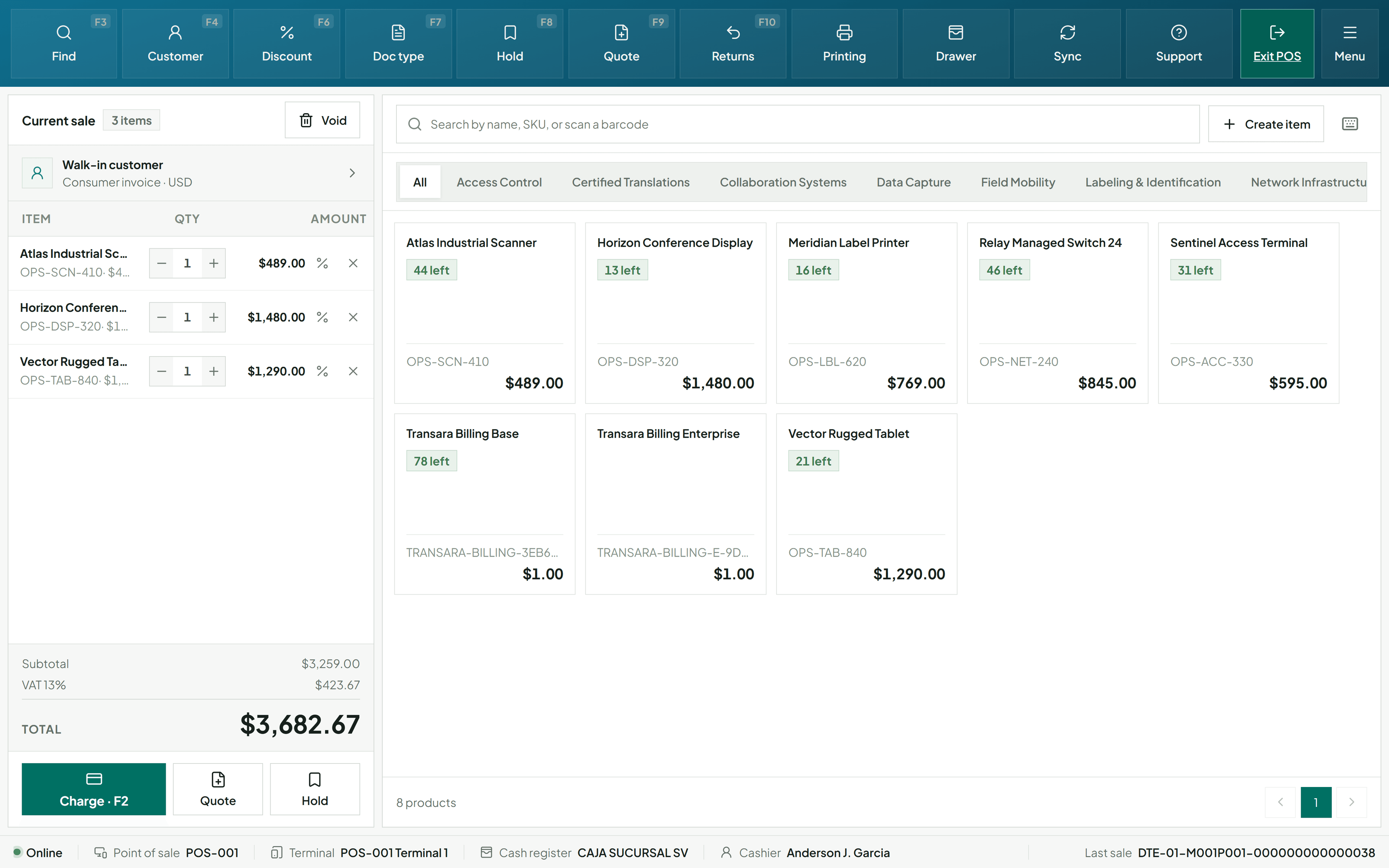
What Billing keeps connected
Keep the whole business behind every sale connected.
Give your team a shared record of customers, payments, inventory and documents. Choose the plan with the level of control your business needs.
Sales and point of sale
Start with who is buying, what is being sold and the terms that apply.
Collections and balances
Keep the payment and what remains due tied to the same sale.
Inventory and purchasing
See what moved, what is available and what must be replenished without starting a second record.
Reports and e-invoicing
Leave the operation ready for review, reporting and electronic documentation.
Plans for the way you work
Start with what your business needs today.
One main location, a growing team or several branches: find your starting point. Electronic invoicing for El Salvador is included in all three plans.
Base
US$15US$11.99/ month
For professionals and entrepreneurs
Sell your products or services. Keep the paperwork in order.
For professionals and entrepreneurs running one main location. Manage customers, quotes, sales and electronic invoices, with simple inventory when you need it.
Customers and catalogue
Your customers, products or services and prices in one place. Optional inventory for a single location.
Sell and collect
Create quotes, sell at the POS or by document, and track each payment.
Cash, expenses and receivables
Review cash activity, outstanding balances, simple expenses and essential sales reports.
Invoice electronically
Issue supported electronic documents in El Salvador, linked to the sale that created them.
Business
US$30US$25.99/ month
For growing businesses
Control what happens before and after every sale.
For growing businesses managing suppliers, inventory and a team. Connect purchase orders, receipts and payments so everyone can follow the work that matters to them.
Customers, sales and collections
Follow quotes, sales, customer balances and electronic documents from the same workspace.
Inventory you can trace
Track receipts, adjustments, transfers and reservations with a record of every movement.
Purchasing and suppliers
Keep supplier, purchase order, receipt and amount due connected.
Finance and operating reports
Manage receivables, payables and accounts. Import statements, reconcile movements and export reports.
Company
US$50US$40.99/ month
For multiple branches and teams
Coordinate every unit without losing control of the whole.
For companies with several branches, warehouses or specialist teams. Give each unit the access it needs while management sees the business as a whole.
Multi-branch commercial operations
Coordinate customers, prices, sales, collections and electronic documents across multiple branches and points of sale.
Multi-location inventory
Control warehouses, transfers, reservations and traceability by lot or serial when the operation requires it.
Purchasing and finance with stronger control
Connect suppliers, approvals, receiving, payables, cash and reconciliation with clearer separation of responsibilities.
Management reporting and audit
Read performance by operating unit and as a whole, with timelines, events and evidence available for review.
Compare plans
Need to check a specific capability?
Compare the details of sales, inventory, finance and team access before choosing your plan.
Commercial operation
Customers and catalogue
- Base
- Customers and fiscal identity, plus products or services with basic pricing.
- Business
- Broader customer, balance, collection, product, service and pricing management.
- Company
- Consistent customer, collection, catalogue and pricing control across operating units.
Sales and invoicing
- Base
- Point-of-sale and back-office sales, quotes, collections and commercial documents.
- Business
- Point-of-sale and back-office sales, quotes, collections and commercial documents.
- Company
- Sales and commercial documents across multiple units with structured supervision.
Inventory and supply
Inventory
- Base
- Optional simple inventory in one location.
- Business
- Warehouses, receiving, adjustments, transfers, reservations and traceability when relevant.
- Company
- Multiple warehouses, transfers, reservations and lot or serial traceability when relevant.
Purchasing and suppliers
- Base
- Simple expense recording rather than a structured purchasing and supplier workflow.
- Business
- Suppliers, purchase orders, receiving, supplier documents and obligations.
- Company
- Procurement, receiving, payables and approvals with stronger separation of responsibilities.
Finance and evidence
Expenses and finance
- Base
- Cash or account activity, collections, essential receivables and simple expenses.
- Business
- Receivables, payables, payments, accounts, statement imports and reconciliation.
- Company
- Receivables, payables, payments, reconciliation, cash planning and formal financial control.
Reports
- Base
- Essential sales and operating visibility.
- Business
- Operating reports and exports across sales, purchasing, inventory and finance.
- Company
- Unit-level and consolidated reporting, control views and audit evidence.
Structure and team
Operating shape
- Base
- One principal operation, one branch and a primary point-of-sale or cash context.
- Business
- A growing operation that may use several points of sale and inventory locations.
- Company
- Multiple branches, points of sale, cash contexts and inventory locations within one company.
Included active users
- Base
- Three active identities with protected ownership and responsibilities that may be combined when compatible.
- Business
- Ten active identities for a functional team with clearer operational responsibilities.
- Company
- Thirty active identities for operating teams, supervisors, controllers and independent review.
Team and access
- Base
- Simple administration, sales, billing and collections, observation and fiscal work.
- Business
- Dedicated sales, inventory, finance, review, observation and fiscal workflows.
- Company
- Multi-branch scopes, branch supervision, protected ownership and formal separation of responsibilities.
Electronic invoicing
Electronic invoicing for El Salvador. In every plan.
Billing supports the same El Salvador document catalogue across Base, Business and Company. The plan changes the operation around the document, not its fiscal validity.
- Enabled market
 El Salvador
- Planned expansion
 Guatemala
 Costa Rica
 Panama
 Nicaragua
Supported document catalogue
Sell in the right commercial context
- DTE 01Invoice
Document a consumer sale and its payment context.
- DTE 03Tax Credit Invoice
Document a sale to a taxpayer when fiscal credit applies.
- DTE 11Export Invoice
Document goods or services sold outside the local market.
Correct a document without breaking its history
- DTE 05Credit Note
Reduce, reverse or correct value from a prior document.
- DTE 06Debit Note
Increase or correct value owed on a prior document.
Move, settle or liquidate an operation
- DTE 04Remission Note
Support the delivery or movement of goods when the transfer needs its own record.
- DTE 08Settlement Voucher
Settle transactions performed in a third-party commercial relationship.
- DTE 09Accounting Settlement Document
Record the accounting settlement associated with qualifying operations.
Handle withholding and special transactions
- DTE 07Withholding Voucher
Record tax withheld as part of a qualifying payment or transaction.
- DTE 14Excluded Subject Invoice
Document a purchase from a person outside the ordinary taxpayer regime.
- DTE 15Donation Voucher
Document a qualifying donation and its supporting information.
Fiscal events
Billing keeps supported events distinct from the DTE catalogue, so the document and the action applied to it retain their own history.
Invalidation event
Record the supported invalidation path without erasing the document that preceded it.
Return event
Keep the return linked to the commercial operation and its fiscal evidence.
Special operations event
Handle supported exceptional scenarios without forcing them into an ordinary sale document.
What happens when the connection drops?
Billing Desktop keeps the point of sale available on Windows, protects locally captured work and coordinates ordered fiscal recovery when connectivity returns.
Operate normally
Billing Desktop stays connected to the cloud operation while service is available.
Detect the interruption
The workstation changes to a controlled offline path instead of losing the transaction.
Recover in order
Pending events are reconciled and transmitted when connectivity returns.
Confirm the outcome
Fiscal status and supporting evidence return to the commercial record.
Locally captured work remains ordered and reviewable until transmission, official status and supporting evidence return to the commercial record.
Operational confidence
Give your team access. Keep control of your business.
Define who can work in each part of the business and keep a record you can review.
Data boundaries
Keep company data separated and operations tied to the correct branch, POS and warehouse.
Responsibility
Give each person the access they need for their work and protect account ownership.
Activity history
Review sensitive actions, the people responsible and the evidence behind them.
Fiscal continuity
Preserve locally captured work during an interruption and reconcile it when the connection returns.
Every plan includes secure sessions, separated company data, protected ownership and basic audit records. Delegation and supervision scale with the plan.
Questions before you choose
Questions before you choose.
Availability, daily use and the next step.
Is Billing only an electronic invoicing system?
No. It also connects customers, sales, collections and reporting. Business and Company add deeper purchasing, inventory and financial controls. Your electronic invoice stays connected to the sale that produced it.
Which plan best fits my operation?
Base fits one primary operation. Business adds purchasing, inventory, obligations and clearer team responsibilities. Company is designed for several branches, warehouses, points of sale or specialized teams that need consolidated supervision. The difference is operating complexity, not the validity of the invoice.
Which documents and invoice formats can I issue?
All three plans offer the same enabled electronic-document catalogue for El Salvador, including invoices, tax-credit invoices and credit notes. You can produce configurable A4 or letter documents and compact thermal receipts for the point of sale.
What happens if connectivity is interrupted?
Billing Desktop keeps the point-of-sale workflow available, protects locally captured events and coordinates an ordered recovery when connectivity returns. Transmission, official status and supporting evidence are then reconciled with the commercial record before the operation is treated as complete.
Is Billing a complete accounting suite?
No. Billing supports receivables, payables, cash and bank movements, evidence, reconciliation and operational planning, but it does not present itself as a complete accounting suite. Its focus is keeping commercial work, fiscal consequences and management evidence connected.
Can I control what my team can access?
Yes. Assign access according to each person's work and your plan's scope. Company adds supervision across branches, warehouses and points of sale. Account ownership stays protected in every plan.
Where is electronic invoicing available?
Electronic invoicing is enabled for El Salvador. Guatemala, Costa Rica, Panama and Nicaragua are the upcoming markets currently contemplated for Billing.
Where can I see prices?
The prices are on this page, beside each plan. Base is US$11.99, Business is US$25.99 and Company is US$40.99 per month. You can also talk with Oridian on WhatsApp while you decide.
A clearer way to run your business.
The prices are on this page. When a plan fits, start the request and we will help you confirm it.